- Turbofan
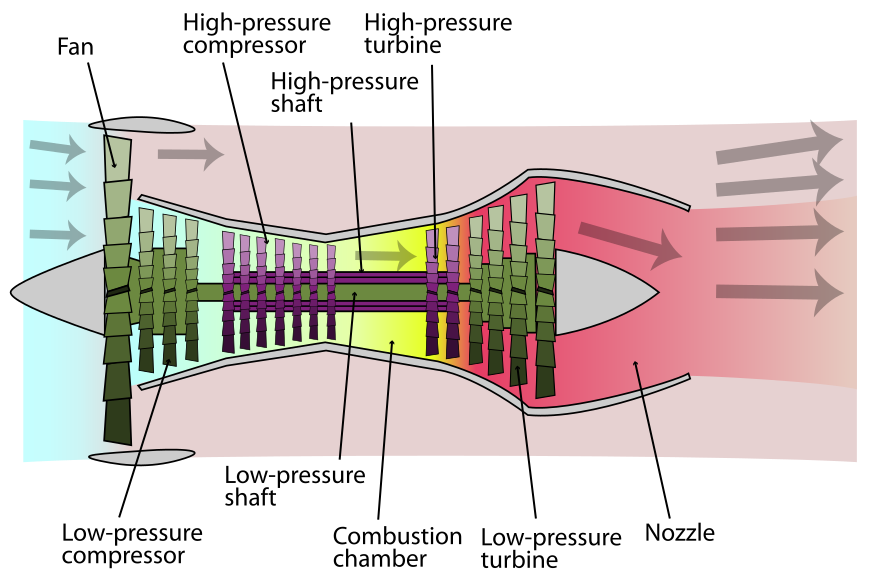
The turbofan or fanjet is a type of airbreathing jet engine that is widely used in aircraft propulsion. The word "turbofan" is aportmanteau of "turbine" and "fan": the turbo portion refers to a gas turbine engine which
takes mechanical energy from combustion,[1] and the fan, a ducted fan that uses the mechanical energy from the gas turbine to accelerate air rearwards. Thus, whereas all the air taken in by a turbojet passes through the turbine (through the combustion chamber), in a turbofan some of that air bypasses the turbine. A turbofan thus can be thought of as a turbojet being used to drive a ducted fan, with both of those contributing to the thrust. The ratio of the mass-flow of air bypassing the engine core compared to the mass-flow of air passing through the core is referred to as the bypass ratio. The engine produces thrust through a combination of these two portions working in concert; engines that use more jet thrust relative to fan thrust are known as low bypass turbofans, conversely those that have considerably more fan thrust than jet thrust are known as high bypass. Most commercial aviation jet engines in use today are of the high-bypass type,[2][3] and most modern military fighter engines are low-bypass.[4][5] Afterburners are not used on high-bypass turbofan engines but may be used on either low-bypass turbofan or turbojet engines.
takes mechanical energy from combustion,[1] and the fan, a ducted fan that uses the mechanical energy from the gas turbine to accelerate air rearwards. Thus, whereas all the air taken in by a turbojet passes through the turbine (through the combustion chamber), in a turbofan some of that air bypasses the turbine. A turbofan thus can be thought of as a turbojet being used to drive a ducted fan, with both of those contributing to the thrust. The ratio of the mass-flow of air bypassing the engine core compared to the mass-flow of air passing through the core is referred to as the bypass ratio. The engine produces thrust through a combination of these two portions working in concert; engines that use more jet thrust relative to fan thrust are known as low bypass turbofans, conversely those that have considerably more fan thrust than jet thrust are known as high bypass. Most commercial aviation jet engines in use today are of the high-bypass type,[2][3] and most modern military fighter engines are low-bypass.[4][5] Afterburners are not used on high-bypass turbofan engines but may be used on either low-bypass turbofan or turbojet engines.
Most of the air flow through a high-bypass turbofan is low-velocity bypass flow: even when combined with the much higher velocity engine exhaust, the average exhaust velocity is considerably lower than in a pure turbojet. Turbojet engine noise is predominately jet noise from the high exhaust velocity, therefore turbofan engines are significantly quieter than a pure-jet of the same thrust with jet noise no longer the predominant source. Other noise sources are the fan, compressor and turbine.[6] Jet noise is reduced withchevrons, sawtooth patterns on the exhaust nozzles,[7] on the Rolls-Royce Trent 1000 and General Electric GEnx engines used on the Boeing 787.
Since the efficiency of propulsion is a function of the relative airspeed of the exhaust to the surrounding air, propellers are most efficient for low speed, pure jets for high speeds, and ducted fans in the middle. Turbofans are thus the most efficient engines in the range of speeds from about 500 to 1,000 km/h (310 to 620 mph), the speed at which most commercial aircraft operate.[8][9]Turbofans retain an efficiency edge over pure jets at low supersonic speeds up to roughly Mach 1.6, but have also been found to be efficient when used with continuous afterburner at Mach 3 and above.[citation needed]
The vast majority of turbofans follow the same basic design, with a large fan at the front of the engine and a relatively small jet engine behind it. There have been a number of variations on this design, however, including rear-mounted fans which can easily be added to an existing pure-jet design, or designs that combine a low-pressure turbine and a fan stage in a single rear-mounted unit.
- Turbojet
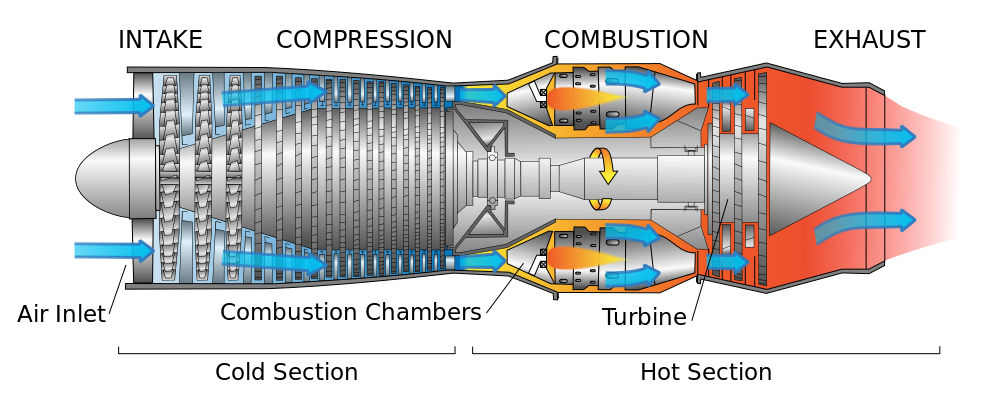
The turbojet is an airbreathing jet engine, usually used in aircraft. It consists of a gas turbine with a propelling nozzle. The gas turbine has an air inlet, a compressor, a combustion chamber, and a turbine (that drives the compressor). The compressed air from the compress
or is heated by the fuel in the combustion chamber and then allowed to expand through the turbine. The turbine exhaust is then expanded in the propelling nozzle where it is accelerated to high speed to provide thrust.[1] Two engineers, Frank Whittle in the United Kingdom and Hans von Ohain in Germany, developed the concept independently into practical engines during the late 1930s.
Turbojets have been replaced in slower aircraft by turboprops because they have better range-specific fuel consumption. At medium speeds, where the propeller is no longer efficient, turboprops have been replaced by turbofans. The turbofan is quieter and has better range-specific fuel consumption than the turbojet. Turbojets are still common in medium range cruise missiles, due to their high exhaust speed, small frontal area, and relative simplicity.
Turbojets have poor efficiency at low vehicle speeds, which limits their usefulness in vehicle other than aircraft. Turbojet engines have been used in isolated cases to power vehicles other than aircraft, typically for attempts on land speed records. Where vehicles are 'turbine powered' this is more commonly by use of a turboshaft engine, a development of the gas turbine engine where an additional turbine is used to drive a rotating output shaft. These are common in helicopters and hovercraft. Turbojets have also been used experimentally to clear snow from switches in railyards.
- TurboProp
 A turboprop engine is a turbine engine that drives an aircraft propeller.[1] In contrast to a turbojet, the engine's exhaust gases do not contain enough energy to create significant thrust, since almost all of the engine's power is used to drive the propeller.
The propeller is coupled to the turbine through a reduction gear that converts the high RPM, low torque output to low RPM, high torque. The propeller itself is normally a constant speed (variable pitch) type similar to that used with larger reciprocatingaircraft engines.[citation needed]
Turboprop engines are generally used on small subsonic aircraft, but some aircraft outfitted with turboprops have cruising speeds in excess of 500 kt (926 km/h, 575 mph).[citation needed] Large military and civil aircraft, such as the Lockheed L-188 Electra and the Tupolev Tu-95, have also used turboprop power. The Airbus A400M is powered by four Europrop TP400engines, which are the third most powerful turboprop engines ever produced, after the Kuznetsov NK-12 and Progress D-27.[citation needed]
In its simplest form a turboprop consists of an intake, compressor, combustor, turbine, and a propelling nozzle. Air is drawn into the intake and compressed by the compressor. Fuel is then added to the compressed air in the combustor, where the fuel-air mixture then combusts. The hot combustion gases expand through the turbine. Some of the power generated by the turbine is used to drive the compressor. The rest is transmitted through the reduction gearing to the propeller. Further expansion of the gases occurs in the propelling nozzle, where the gases exhaust to atmospheric pressure. The propelling nozzle provides a relatively small proportion of the thrust generated by a turboprop.
Turboprops are most efficient at flight speeds below 725 km/h (450 mph; 390 knots) because the jet velocity of the propeller (and exhaust) is relatively low. Due to the high price of turboprop engines, they are mostly used where high-performance short-takeoff and landing (STOL) capability and efficiency at modest flight speeds are required. The most common application of turboprop engines in civilian aviation is in small commuter aircraft, where their greater power and reliability thanreciprocating engines offsets their higher initial cost and fuel consumption. Turboprop airliners now operate at near the same speed as small turbofan-powered aircraft but burn two-thirds of the fuel per passenger.[2] However, compared to a turbojet (which can fly at high altitude for enhanced speed and fuel efficiency) a propeller aircraft has a much lower ceiling. Turboprop-powered aircraft have become popular for bush airplanes such as the Cessna Caravan and Quest Kodiakas jet fuel is easier to obtain in remote areas than is aviation-grade gasoline (avgas)
A turboprop engine is a turbine engine that drives an aircraft propeller.[1] In contrast to a turbojet, the engine's exhaust gases do not contain enough energy to create significant thrust, since almost all of the engine's power is used to drive the propeller.
The propeller is coupled to the turbine through a reduction gear that converts the high RPM, low torque output to low RPM, high torque. The propeller itself is normally a constant speed (variable pitch) type similar to that used with larger reciprocatingaircraft engines.[citation needed]
Turboprop engines are generally used on small subsonic aircraft, but some aircraft outfitted with turboprops have cruising speeds in excess of 500 kt (926 km/h, 575 mph).[citation needed] Large military and civil aircraft, such as the Lockheed L-188 Electra and the Tupolev Tu-95, have also used turboprop power. The Airbus A400M is powered by four Europrop TP400engines, which are the third most powerful turboprop engines ever produced, after the Kuznetsov NK-12 and Progress D-27.[citation needed]
In its simplest form a turboprop consists of an intake, compressor, combustor, turbine, and a propelling nozzle. Air is drawn into the intake and compressed by the compressor. Fuel is then added to the compressed air in the combustor, where the fuel-air mixture then combusts. The hot combustion gases expand through the turbine. Some of the power generated by the turbine is used to drive the compressor. The rest is transmitted through the reduction gearing to the propeller. Further expansion of the gases occurs in the propelling nozzle, where the gases exhaust to atmospheric pressure. The propelling nozzle provides a relatively small proportion of the thrust generated by a turboprop.
Turboprops are most efficient at flight speeds below 725 km/h (450 mph; 390 knots) because the jet velocity of the propeller (and exhaust) is relatively low. Due to the high price of turboprop engines, they are mostly used where high-performance short-takeoff and landing (STOL) capability and efficiency at modest flight speeds are required. The most common application of turboprop engines in civilian aviation is in small commuter aircraft, where their greater power and reliability thanreciprocating engines offsets their higher initial cost and fuel consumption. Turboprop airliners now operate at near the same speed as small turbofan-powered aircraft but burn two-thirds of the fuel per passenger.[2] However, compared to a turbojet (which can fly at high altitude for enhanced speed and fuel efficiency) a propeller aircraft has a much lower ceiling. Turboprop-powered aircraft have become popular for bush airplanes such as the Cessna Caravan and Quest Kodiakas jet fuel is easier to obtain in remote areas than is aviation-grade gasoline (avgas)
The turbojet is an airbreathing jet engine, usually used in aircraft. It consists of a gas turbine with a propelling nozzle. The gas turbine has an air inlet, a compressor, a combustion chamber, and a turbine (that drives the compressor). The compressed air from the compress
or is heated by the fuel in the combustion chamber and then allowed to expand through the turbine. The turbine exhaust is then expanded in the propelling nozzle where it is accelerated to high speed to provide thrust.[1] Two engineers, Frank Whittle in the United Kingdom and Hans von Ohain in Germany, developed the concept independently into practical engines during the late 1930s.
Turbojets have been replaced in slower aircraft by turboprops because they have better range-specific fuel consumption. At medium speeds, where the propeller is no longer efficient, turboprops have been replaced by turbofans. The turbofan is quieter and has better range-specific fuel consumption than the turbojet. Turbojets are still common in medium range cruise missiles, due to their high exhaust speed, small frontal area, and relative simplicity.
Turbojets have poor efficiency at low vehicle speeds, which limits their usefulness in vehicle other than aircraft. Turbojet engines have been used in isolated cases to power vehicles other than aircraft, typically for attempts on land speed records. Where vehicles are 'turbine powered' this is more commonly by use of a turboshaft engine, a development of the gas turbine engine where an additional turbine is used to drive a rotating output shaft. These are common in helicopters and hovercraft. Turbojets have also been used experimentally to clear snow from switches in railyards.
- TurboProp
A turboprop engine is a turbine engine that drives an aircraft propeller.[1] In contrast to a turbojet, the engine's exhaust gases do not contain enough energy to create significant thrust, since almost all of the engine's power is used to drive the propeller.
The propeller is coupled to the turbine through a reduction gear that converts the high RPM, low torque output to low RPM, high torque. The propeller itself is normally a constant speed (variable pitch) type similar to that used with larger reciprocatingaircraft engines.[citation needed]
Turboprop engines are generally used on small subsonic aircraft, but some aircraft outfitted with turboprops have cruising speeds in excess of 500 kt (926 km/h, 575 mph).[citation needed] Large military and civil aircraft, such as the Lockheed L-188 Electra and the Tupolev Tu-95, have also used turboprop power. The Airbus A400M is powered by four Europrop TP400engines, which are the third most powerful turboprop engines ever produced, after the Kuznetsov NK-12 and Progress D-27.[citation needed]
In its simplest form a turboprop consists of an intake, compressor, combustor, turbine, and a propelling nozzle. Air is drawn into the intake and compressed by the compressor. Fuel is then added to the compressed air in the combustor, where the fuel-air mixture then combusts. The hot combustion gases expand through the turbine. Some of the power generated by the turbine is used to drive the compressor. The rest is transmitted through the reduction gearing to the propeller. Further expansion of the gases occurs in the propelling nozzle, where the gases exhaust to atmospheric pressure. The propelling nozzle provides a relatively small proportion of the thrust generated by a turboprop.
Turboprops are most efficient at flight speeds below 725 km/h (450 mph; 390 knots) because the jet velocity of the propeller (and exhaust) is relatively low. Due to the high price of turboprop engines, they are mostly used where high-performance short-takeoff and landing (STOL) capability and efficiency at modest flight speeds are required. The most common application of turboprop engines in civilian aviation is in small commuter aircraft, where their greater power and reliability thanreciprocating engines offsets their higher initial cost and fuel consumption. Turboprop airliners now operate at near the same speed as small turbofan-powered aircraft but burn two-thirds of the fuel per passenger.[2] However, compared to a turbojet (which can fly at high altitude for enhanced speed and fuel efficiency) a propeller aircraft has a much lower ceiling. Turboprop-powered aircraft have become popular for bush airplanes such as the Cessna Caravan and Quest Kodiakas jet fuel is easier to obtain in remote areas than is aviation-grade gasoline (avgas)

No comments:
Post a Comment